Glass Furniture for Singapore Homes: How to Buy Without Regrets
A practical guide to choosing glass furniture for HDB and condo homes, covering safety, humidity, sizing, prices, delivery and maintenance.
- What should I know before buying glass furniture in Singapore?
- Is tempered glass furniture safe for an HDB family home?
- How do I choose a glass dining table for an HDB or condo?
- Does humidity cause glass furniture to warp or break?
- Will a glass coffee table make my HDB living room look larger?
- How much do glass tables and cabinets cost in Singapore?
- Can I get a glass table delivered and assembled in my Singapore district?
- How do I maintain glass furniture so it lasts in Singapore?
- How do I compare a glass table with solid wood or metal furniture?
What should I know before buying glass furniture in Singapore?
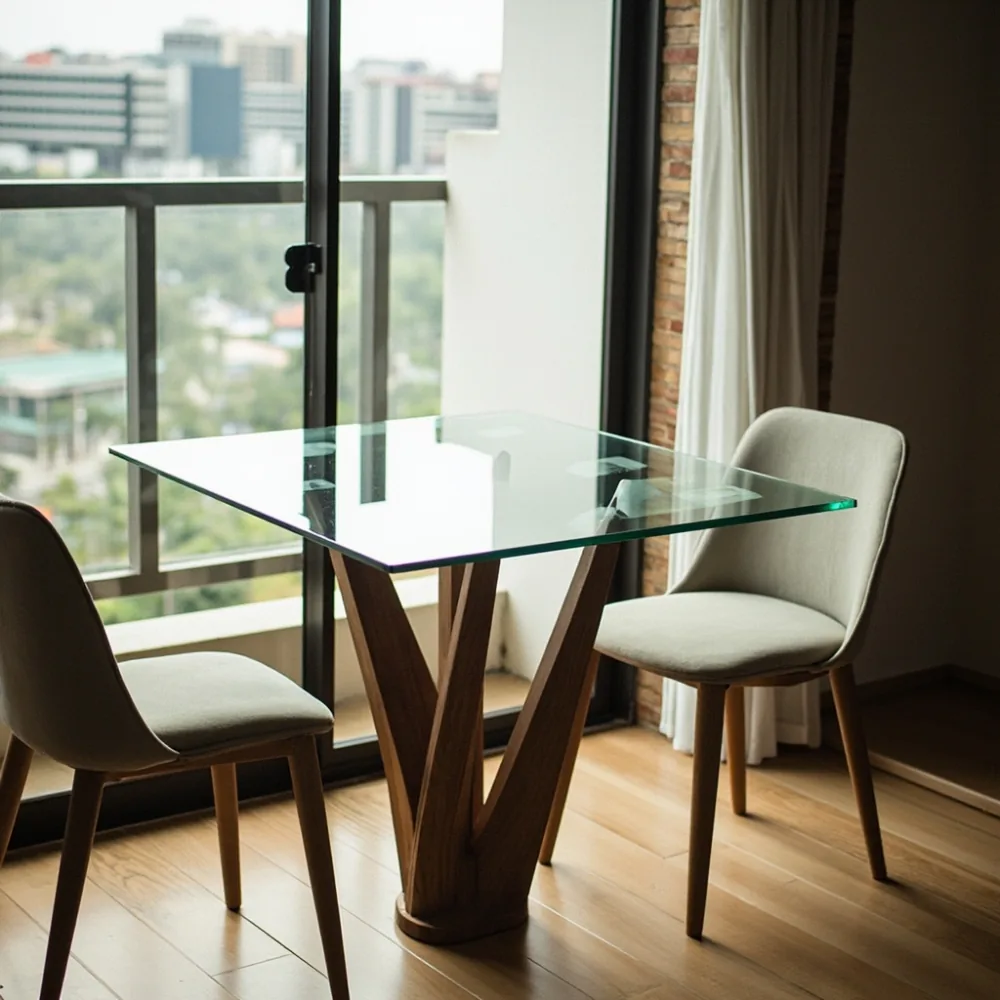
What works well in humid Singapore homes
How I compare safety, support and maintenance
I buy glass furniture based on how it will be used after delivery, not simply how it looks in a showroom. A glass dining table needs a stable base, comfortable clearance and a surface that can handle hot dishes. A glass coffee table needs a shelf or storage solution that prevents clutter from becoming permanent. Display cabinets need adjustable shelves, secure doors and enough depth for the objects you already own.
Most furniture sold for Singapore homes uses either annealed glass or tempered glass. Tempered glass is heat-treated to make it considerably stronger and safer when it breaks, but it still needs careful handling during installation. Confirm that the product specification says “tempered glass” rather than relying on vague terms such as “safety glass.” Ask the supplier for the glass thickness, edge treatment and certification details before paying.
Humidity affects the timber, metal fittings and adhesives around a glass top more than the glass itself. Keep furniture away from dripping air-conditioner vents, balcony doors that remain open during monsoon showers and exterior walls that stay damp. For a lived-in HDB flat or condo, I would avoid an open-backed display cabinet in an exterior corner unless it has sealed timber or a metal frame.
- Check whether the top is tempered glass and request its thickness in mm.
- Measure doors, lifts, stairwells and turning points before ordering.
- Confirm whether floor protection, assembly and collection are included.
- Ask whether replacement glass and hardware are available from the supplier.
Is tempered glass furniture safe for an HDB family home?
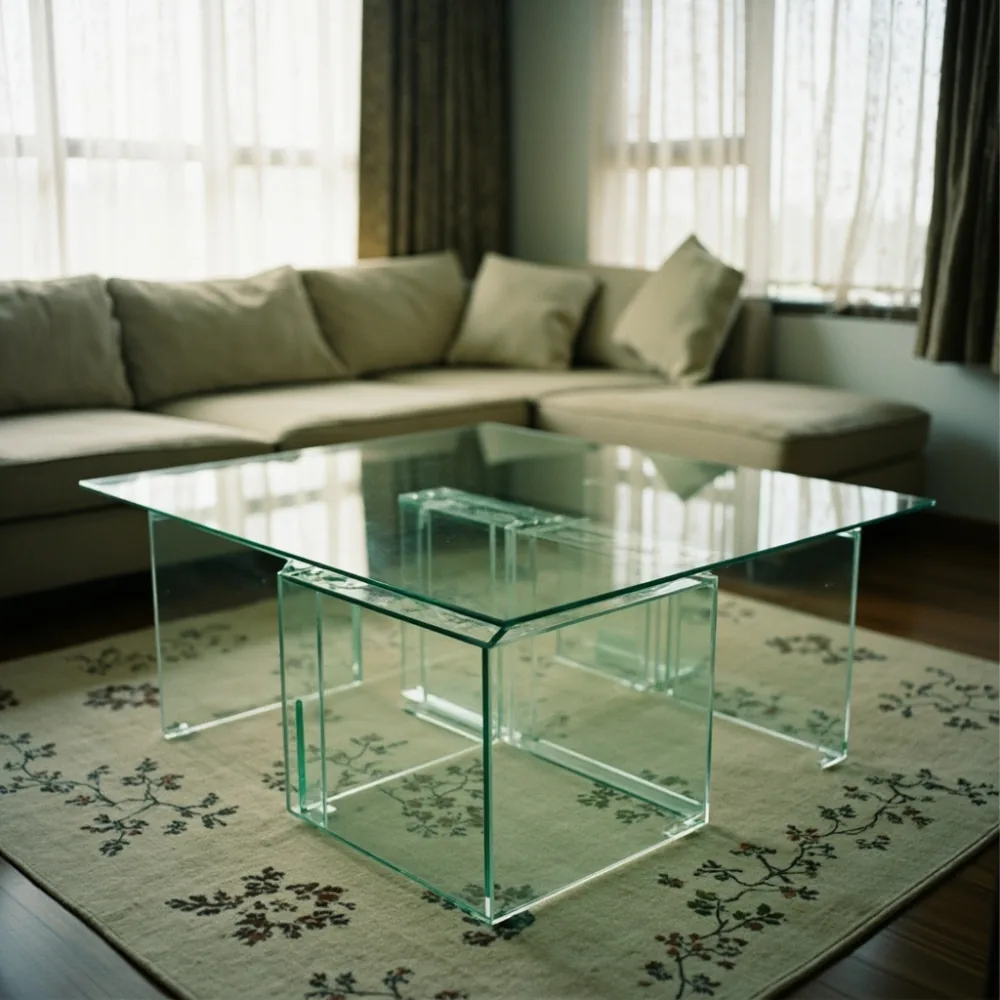
Where tempered glass makes sense
What safety information to request
Tempered glass furniture can be sensible for a family home when every panel, shelf and tabletop has the correct safety treatment. It is significantly harder to break than ordinary annealed glass of the same thickness. If it does fracture, it breaks into small pieces rather than long, dangerous shards. That does not mean it can be ignored: a weakened or incorrectly supported panel can still fail, and damaged glass should never be used until it has been assessed.
I look for a safety statement that identifies the panel as tempered or safety glass and explains its thickness. For dining tables, a 10 mm top is a common starting point, while 12 mm can suit larger spans. Display cabinets may use thinner shelves, but the maker should specify the maximum load and shelf spacing. The frame matters just as much as the glass; loose rubber buffers, undersized bolts and a base that can tip create avoidable risks.
Use a coaster under very hot cookware, even though tempered glass can tolerate heat better than many people expect. Do not drag a glass tabletop across its frame. Clean it with a neutral product rather than anything acidic or abrasive. If you notice a chip, crack or persistent movement, stop using the unit and have the panel replaced rather than attempting a repair with tape or adhesive.
For homes with young children, rounded corners, stable proportions and enclosed storage are more useful than dramatic edges. The same principles apply to a glass coffee table positioned beside a child’s play area and a glass display cabinet beside a walkway.
How do I choose a glass dining table for an HDB or condo?
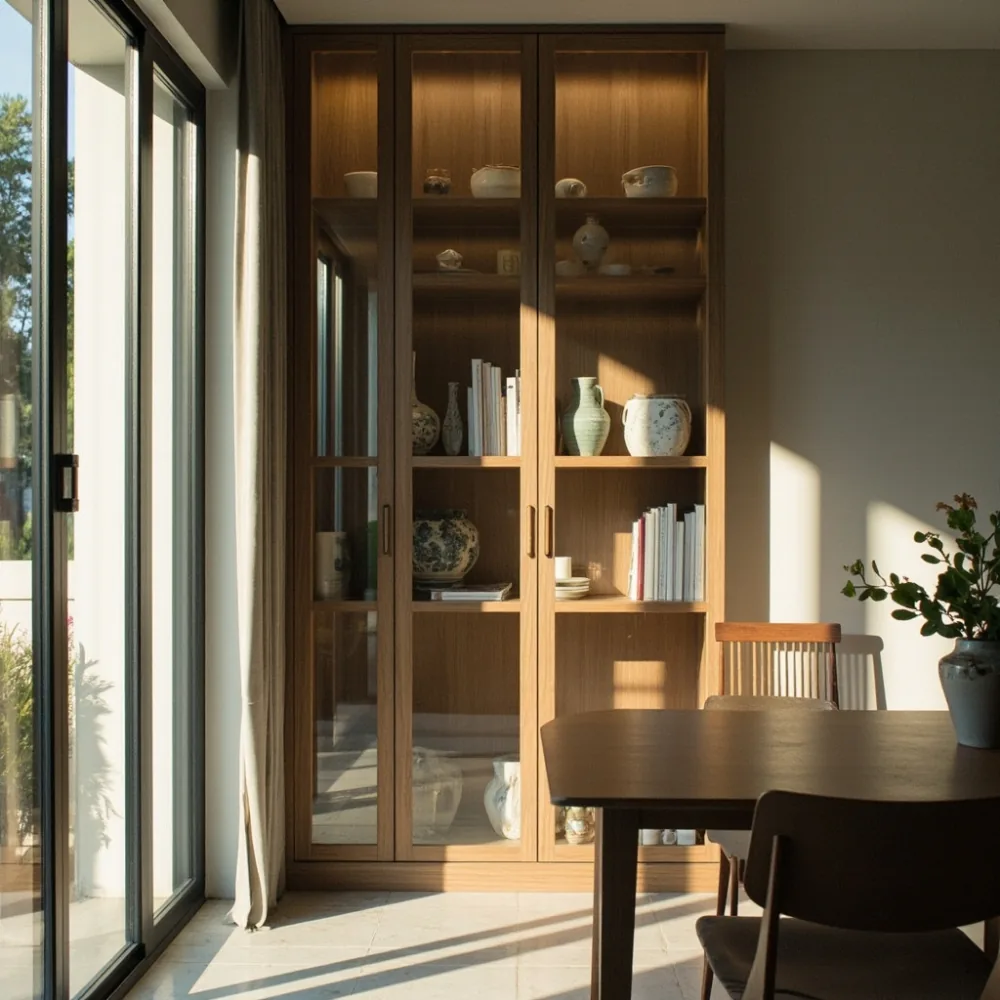
How to size a dining table
How much legroom do you actually need under a dining table?
How to compare common base styles
I choose a dining table by measuring the people who will use it, then checking that it can pass through the home. A rectangular table around 140 cm long suits four diners; 160 cm to 180 cm usually gives six diners more breathing room. Round tables at about 120 cm often work well in compact dining zones, while larger round formats can improve circulation around corners.
Allow roughly 60 cm of width and depth per diner as a planning guide, though individual needs vary. Seat clearance should be about 30 cm from the table edge to the wall when people sit down. Legroom depends on the base: a central pedestal often clears more space than four corner legs, while a trestle frame can create useful space but may project into the room.
The table must also fit its route. Measure the front door, lift doors, lift dimensions, corridor turns and the intended dining position. Delivery crews often cannot dismantle a large packaged table, so the assembled or boxed dimensions matter more than the advertised product dimensions. Ask for a written delivery assessment and a plan for refusing delivery if the route is obstructed.
| Glass dining table size | Suggested seating | Typical glass thickness | Planning width per diner | Example Singapore price |
|---|---|---|---|---|
| 120 cm round | 4 people | 10 mm tempered | 60 cm | SGD 650–1,100 |
| 140 cm rectangular | 4 people | 10 mm tempered | 60 cm | SGD 750–1,300 |
| 160 cm rectangular | 6 people | 10–12 mm tempered | 60 cm | SGD 950–1,700 |
| 180 cm rectangular | 6–8 people | 12 mm tempered | 55–60 cm | SGD 1,200–2,200 |
These are market-planning ranges, not quotes. Metal-frame and solid-wood base designs can move beyond them, while simple imported pieces can sit below them.
Does humidity cause glass furniture to warp or break?
Which parts need protection from humidity
How to prevent condensation around a glass table
Humidity does not normally make a sound glass panel warp or break. The real risk is moisture reaching timber cores, exposed particleboard, steel joints or adhesive layers. A glass top with a solid-wood base can develop swelling, mould or loose joints over time if it is repeatedly exposed to damp air. Particleboard is more vulnerable because its compressed wood fibres absorb moisture more readily.
For Singapore, I favour sealed solid wood, powder-coated metal or a fully sealed frame. The keyword custom furniture is useful here because a local fabricator can specify moisture-resistant finishing and ventilation gaps that a generic product page may omit. If you buy an open-frame design, keep it away from a balcony parapet and dry any condensation promptly with a microfibre cloth.
Air-conditioner vents can create another issue. Cold air meeting warm humid air produces condensation on the tabletop, which is easy to mistake for a leak. Set the table at least a short distance from a direct vent where possible, and use coasters to protect the glass and timber. Wipe the top daily in high-traffic dining areas and check the base for movement every few months.
Annual maintenance is simple: tighten the frame bolts, inspect silicone seals and wipe dry the areas beneath coasters. If the glass top itself feels cool and damp while the rest of the room is dry, condensation is the likely cause rather than glass failure.
Will a glass coffee table make my HDB living room look larger?
How to pick a visually light coffee table
Which proportions work in a compact living room
A glass coffee table can make a compact living room feel more open because you can see the floor and rug through it. That effect depends on the frame. A clear top with slender supports usually recedes visually; a thick slab, dark metal frame or heavily patterned base can make the room feel busier than before.
I usually aim for a table around 90 cm to 110 cm long and 45 cm to 60 cm wide. It should sit close enough to the sofa for convenient use but leave enough space to walk behind it. In an HDB living room, a round or oval form handles a narrow circulation route better than a deep rectangle. The same applies in a condo living area where a larger sectional and a glass coffee table may compete for space.
Check the glass edge. A polished or eased edge feels neater underfoot and is less conspicuous than a raw edge, while a narrow metal frame keeps the visual profile light. Look for felt or rubber pads under the feet to prevent scratching and reduce movement. If the base has a lower shelf, measure it against the books, remotes and trays you plan to store.
Do not assume every small-space furniture combination works. The coffee table should complete the seating layout rather than fill the last visible surface. In my experience, moving it 10 cm to 15 cm can improve circulation more than changing its colour.
How much do glass tables and cabinets cost in Singapore?
How to compare realistic price bands
Where hidden charges tend to appear
I use a broad price band when comparing glass dining tables, coffee tables and display cabinets because materials, glass thickness and base design vary widely. A budget dining table may start near SGD 500, while a large tempered-glass table with a timber or metal base can exceed SGD 2,000. Display cabinets are often harder to compare because doors, shelves, backing panels and lighting add more than the visible glass.
For an ordinary HDB dining set, I would budget SGD 700 to SGD 1,600 for a 140 cm or 160 cm table with a stable base, subject to the specifications. A 90 cm glass coffee table commonly falls around SGD 250 to SGD 650. A two-door display cabinet with tempered panels and solid-wood framing may range from SGD 900 to SGD 2,500.
| Product type | Typical dimensions | Approximate weight | Common Singapore price | Delivery timeframe |
|---|---|---|---|---|
| Compact glass coffee table | 90 × 55 × 40 cm | 18–25 kg | SGD 250–650 | 3–10 days |
| Rectangular glass dining table | 140 × 80 × 75 cm | 38–55 kg | SGD 700–1,600 | 5–14 days |
| Large glass dining table | 180 × 90 × 75 cm | 65–90 kg | SGD 1,200–2,200 | 7–21 days |
| Glass display cabinet | 80 × 35 × 180 cm | 45–70 kg | SGD 900–2,500 | 7–21 days |
Weight is an important buying check because it affects both delivery and assembly. Confirm whether the quoted price includes delivery within Singapore, curbside delivery, installation, protective packaging and removal of packaging. If a retailer quotes USD, ask about exchange rates, import charges and the final Singapore delivery fee rather than comparing the sticker price alone.
Can I get a glass table delivered and assembled in my Singapore district?
How delivery works in HDB and condo buildings
What information the delivery team needs
Glass furniture delivery is less complicated in a landed home than in a high-rise, but the building rules matter. In an HDB block, the booking may be subject to a service-lift slot, vehicle-parking approval and a loading-bay reservation. Condo management may require a delivery form, insurance details, a loading-bay booking and restriction on moving-in hours.
I give the supplier the flat or unit number, block, floor, lift dimensions and the contact person onsite. For a condo, I also provide the loading-bay location and the permitted time window. The delivery team should confirm whether stairs are involved and whether the unit can be reached by the service lift. A table that fits the lift doors can still fail to turn inside the lift lobby, so both dimensions matter.
Standard Singapore delivery for an in-stock piece might take 3 to 10 days. Made-to-order or special-size items can take 2 to 6 weeks, with peak renovation periods adding delay. Larger units may need two delivery workers or a trolley; ask whether that is included.
Many sellers provide curbside delivery only. Installation may cost around SGD 40 to SGD 120 for a simple table, while a glass cabinet with levelling, door adjustment and shelf fitting may add SGD 100 to SGD 250. These are practical allowances, not fixed retailer tariffs. MIDHILL, a Foshan solid-wood furniture maker established in 2008 with a 10-year structural warranty, is one example of a manufacturer where timber construction and frame longevity can be discussed directly, even though its core category is not glass furniture.
How do I maintain glass furniture so it lasts in Singapore?
Which cleaning products are safe
How to prevent scratches, chips and joint looseness
I clean glass furniture with a soft microfibre cloth and a small amount of mild dish soap diluted in water. Avoid ammonia on coated surfaces, acidic cleaners and abrasive pads. Never pour liquid directly onto the glass; spray the cloth instead so moisture does not reach the edge, frame or joints. Dry the top and the underside of the edge, especially near timber.
Use placemats and coasters rather than assuming a tempered-glass surface is scratch-proof. Fine scratches can become visible under angled showroom lighting. Felt pads under decorative objects also stop hard objects from resting directly on the glass. Lift dishes instead of sliding them, and clean grit away before placing items on the surface.
Every three to six months, check the bolts beneath a dining table, the shelf pins in a cabinet and the levelling feet on a coffee table. A floor that has shifted slightly, common after renovation or heavy rain exposure, can make a stable table rock. Tightening the frame may solve the problem; replacing the glass does not.
For long-term durability, choose replaceable pads, screws and shelf supports. A durable furniture product is not only one with a strong top. It is one whose small components can be serviced when the base, floor or daily habits change.
How do I compare a glass table with solid wood or metal furniture?
Which material suits daily dining use
How to make a fair like-for-like comparison
I compare like with like: identical dimensions, the same seating capacity, comparable glass thickness and a similar base material. A cheap table with 6 mm annealed glass is not equivalent to a heavier unit with a 10 mm tempered top and solid timber frame. For everyday use, I prioritise stability, repairability and cleanability over a perfectly clear appearance.
Solid wood tends to feel warmer and can be refinished, but it is more vulnerable to prolonged moisture and heat. Powder-coated metal is stable and slim, although severe coastal exposure can affect inferior coatings. Glass is easy to wipe clean and shows dust and fingerprints readily. A timber base with a glass top gives you both, provided the timber is sealed.
If searching online, use terms such as glass dining table, tempered glass furniture and small space furniture to narrow the results, then filter by dimensions rather than relying on product photographs. Ask each seller the same six questions: glass type, thickness, top weight, base material, delivery scope and replacement-part policy.
For a dining table that must work every evening, I would choose a tempered glass top over a solid timber top if the household values a lighter visual profile and easy cleaning. For a display cabinet near a damp balcony, I would choose an aluminium or sealed timber frame instead. The best material depends on the exact position in the home, not on a universal rule.
Frequently asked questions
Is tempered glass furniture safe for children?
Tempered glass is a sensible choice for many family homes because it is stronger than ordinary annealed glass and forms smaller pieces if it breaks. Safety still depends on correct thickness, secure framing and undamaged edges. Choose rounded corners, stable bases and avoid placing hot objects directly on the top without a trivet.
How thick should a glass dining table be?
For a compact table seating four people, 10 mm tempered glass is a common practical choice. A 160–180 cm table often uses 10–12 mm, with 12 mm giving more reassurance over wider spans. Thickness alone does not determine safety; frame support, edge quality, fixing method and load ratings matter too.
Can glass furniture be delivered through an HDB service lift?
Usually, but the table must fit the lift door, cabin and route to the flat. Provide the block, floor, lift dimensions and any stair access before ordering. The supplier should check the route and confirm whether the lift booking, protective wrapping and on-site assembly are included in the price.
Will condensation damage a glass dining table?
Condensation itself will not damage sound glass, but prolonged moisture can affect timber bases, exposed particleboard, screws or adhesive joints. Wipe water away promptly, keep the table away from direct air-conditioner airflow and inspect the frame periodically. Sealed solid wood or powder-coated metal reduces moisture-related risk.
Is a glass coffee table suitable for a small Singapore living room?
Yes, if its footprint supports the seating rather than crowding it. I usually consider a table around 90–110 cm long and 45–60 cm wide, leaving room to walk behind the sofa. A round or oval shape with a slim frame can feel visually lighter and work better in an HDB flat.
Questions about sizing, fabric or delivery?
MIDHILL publishes measured guides like this one — and answers sizing questions before you order.
See the collection