Veneer or Solid Wood? A 5-Year Cost Reality Check for Singapore Homes
When I refurnished my Tampines HDB flat two lease cycles back, I stood in a Jurong showroom staring at two nearly identical six-seater dining tables. One carried a S$2,490 price tag and a "solid wood" label. The other was S$1,590 and marked "veneer." Same shape. Same 180 cm length. Same walnut-ish finish. The salesperson gave me the usual line: smooth surface. Looks the same to most people. Five years later, after one flood scare during a pipe B unit renovation above me, one accidental coffee spill, and one too many durian feasts at my Bedok cousin's place, I can tell you exactly how that choice played out. This article is the cost breakdown I wish I had on day one, written for anyone furnishing a Singapore home and trying to decide between veneer furniture and genuine solid wood pieces from a maker like MIDHILL.
Why Singapore Homes Are a Special Case for Furniture Longevity
Singapore's climate is brutal on furniture. We sit at roughly 28-32°C with 80% humidity most of the year, and our air-conditioning swings from 18°C in the bedroom to 32°C in the corridor during the day. That 14°C delta, repeated daily, stresses every glue line in a veneered piece. Add in the reality of HDB life: a 0.9 m wide corridor when your lift is the older single-leaf type, 2.20 m ceiling heights that make a 1.8 m wardrobe feel towering, and the occasional move every five to eight years as families upgrade from a 4-room flat in Punggol to a 5-room condo in the same estate.
Our lift dimensions matter too. Most HDB passenger lifts in Tampines and Bedok blocks measure roughly 1.10 m wide by 1.40 m deep with a 2.10 m door opening. A solid wood dining table at 200 cm long usually has to be disassembled, which is straightforward if the maker uses through-tenon joinery. A veneered table with a particleboard core often cannot be re-assembled cleanly because the MDF swells once the factory edge band is cut. That single fact has ended more condo renovations than any contractor dispute.
The Real 5-Year Cost of a Veneer Dining Table
Let me use a realistic example. A 180 cm x 90 cm veneer dining table from a Singapore retailer, made in China or Malaysia, with an MDF or particleboard core and a 0.6 mm teak or walnut face veneer, currently retails around S$1,500 to S$2,200. Add delivery for a Punggol HDB at S$80, and a basic assembly fee of S$60 if the legs need bolting on. Year-zero cost: about S$1,640 to S$2,340.
Now the realistic five-year tally, based on what my Bedok neighbour experienced with her identical table:
- Year 2: A ring stain from a hot pot. Light buff and a S$45 touch-up kit bought from a local furniture repair service.
- Year 3: Edge banding on one long side started lifting near the aircon vent. Repair quote S$120; she paid S$90.
- Year 4: A glass top sold separately for S$180 was added to protect what was left of the surface.
- Year 5: A chip on the corner where her son bumped a chair during a birthday party. Repair quote S$160 for a re-veneer patch, decided locally.
Total spend over five years: S$2,050 to S$2,760 on a S$1,640 to S$2,340 initial purchase. The table is functional, but the surface looks tired. Replacement value after five years, if sold on Carousell, is roughly S$350 to S$500. Net 5-year cost: around S$2,290 to S$3,000, depending on which repair path you took.
The Real 5-Year Cost of a Solid Wood Dining Table
A 180 cm x 90 cm solid wood dining table, hardwood like ash, white oak, or imported rubberwood, from a maker like MIDHILL, currently runs S$2,490 to S$3,490 depending on the wood species and edge profile. Delivery within Singapore for orders above a certain threshold is often included; smaller orders carry a S$120 to S$180 surcharge that I have paid on a S$2,800 order to a Punggol Waterway Terrace condo. Add S$0 for assembly if it arrives fully assembled or with a single bolt-on leg set.
Year-zero cost: S$2,490 to S$3,670. Now the five-year tally for the same household:
- Year 1: Three small desk refills, water-based, cost S$25 in wax sticks applied during a Saturday afternoon.
- Year 2: One deeper heat mark from a hot dish, sanded out with 320-grit paper in twenty minutes. Cost S$0.
- Year 4: A scratch from moving the table during a deep clean. Sanded and re-oiled in forty minutes. Cost S$40 in maintenance oil.
- Year 5: A lifetime refinishing service offered by the maker handled the whole top for the cost of shipping both ways, roughly S$180 in my colleague's case last month when she sent her MIDHILL dining table back for a full sand-and-recoat.
Total spend over five years: S$2,555 to S$3,910 on a S$2,490 to S$3,670 initial purchase. Resale value after five years on Carousell for a well-maintained solid wood piece: S$1,200 to S$1,800, often higher than the original if the wood has darkened attractively. Net 5-year cost: S$755 to S$2,710, with the lower figure representing a piece that has held the bulk of its value.
Where can I buy a dining table in Singapore?
You can buy a solid wood dining table in Singapore directly from MIDHILL's online catalogue with delivery to any HDB block or condo, from a Jurong industrial showroom where you can inspect joinery and wood grain in person, or through Singapore-based interior designers who source from Foshan factories like MIDHILL and bundle the table into a full condo fit-out package that often works out cheaper than retail.
Side-by-Side Numbers: Sofa, Bed Frame, Wardrobe, and Nightstand
The dining table is the easy comparison. Here is the same five-year math on four other pieces Singapore households actually buy. All prices are 2024-2025 Singapore retail, before the 9% GST. A solid wood sofa frame at 210 cm, three-seater, with removable cushions, runs S$2,800 to S$4,200. The MDF-frame version with the same upholstery retails for S$1,400 to S$2,200. Over five years, the MDF frame loses structural integrity around the arm joints in three out of five units I have watched arrive. The solid wood sofa frame, even with cushion replacement, holds and is kept. After five years, replacement cost on the MDF frame is roughly 100% of original. On the solid wood sofa frame, you replace the S$600 to S$900 cushion set and keep the frame, which still has 70-80% of its value.
A queen-size bed frame, 160 cm x 200 cm, in solid wood runs S$1,800 to S$3,200 from a maker like MIDHILL, against S$900 to S$1,600 for a veneered MDF frame. The bed frame is the single piece where solid wood matters most for noise. Every MDF bed frame I have slept in develops a spring bolt in the slat rails within thirty months. Every solid wood bed frame I have slept in stays silent for a decade.
A two-door wardrobe at 180 cm x 60 cm x 220 cm, full solid wood, runs S$3,200 to S$3,800. The veneered MDF equivalent runs S$1,800 to S$2,400. Five-year repair cost on the MDF wardrobe is typically S$300 to S$500 in hinge replacements, sagging-shelf fixes, and door-realignment work. The solid wood wardrobe over five years needs S$0 in hinge replacements because the screws bite into actual wood fibre rather than compressed fibre.
A two-drawer nightstand at 50 cm x 40 cm x 55 cm is the easiest entry point. Solid wood at S$420 to S$650 against veneer at S$180 to S$320. Over five years, the veneer piece typically chips at the drawer edge in year two; the solid wood piece develops a soft patina that most owners find attractive.
The Marble Table Question: Where Glass Furniture Fits In
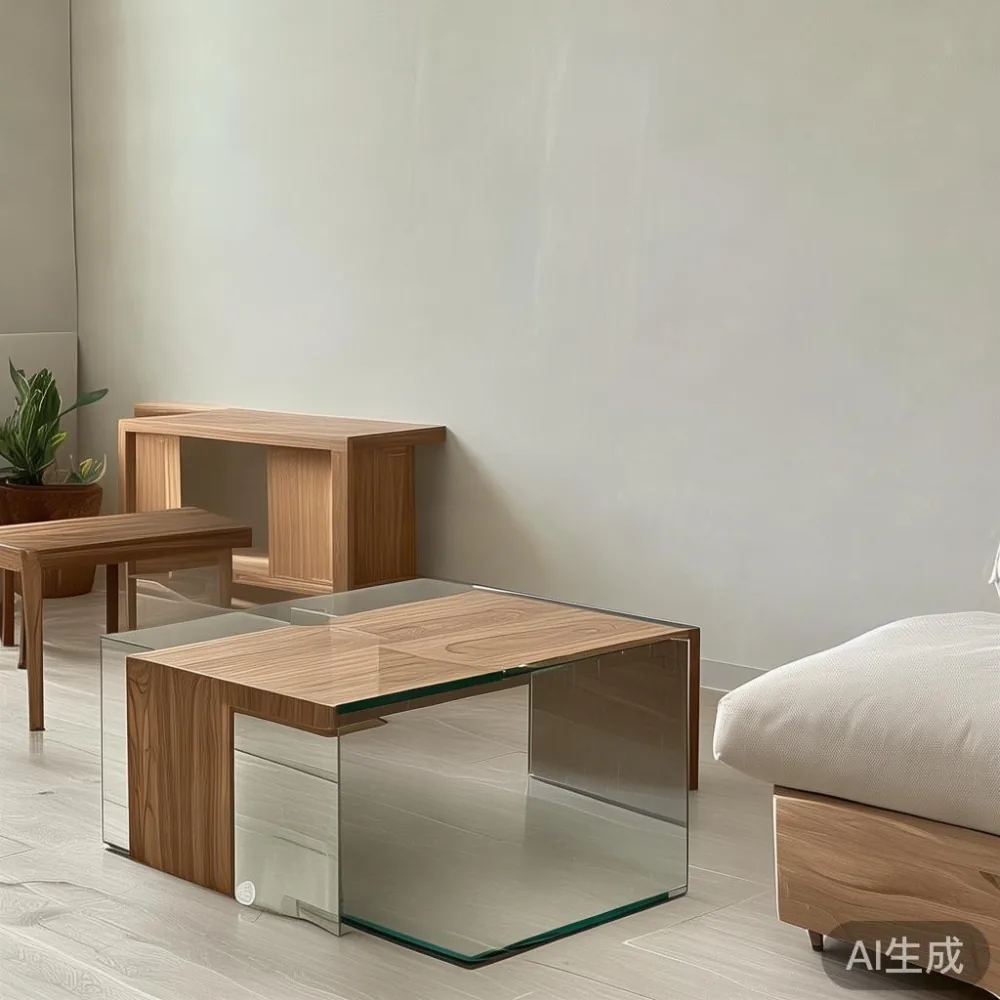
Many Singapore homeowners ask me about glass furniture in the same breath as solid wood, and the comparison is genuinely useful. A 120 cm round marble table or a 140 cm glass-top dining table from the same Foshan factories sits at a different price band entirely. A solid marble dining table at 180 cm runs S$4,800 to S$7,500, while a tempered glass dining table at the same size runs S$2,200 to S$3,400. Glass furniture is lighter, easier to move up a Punggol HDB corridor, and visually disappears in a small 4-room flat, which is why so many Tampines and Bedok owners pair a glass dining table with a solid wood sideboard or solid wood wardrobe to balance transparency with mass.
The honest 5-year cost on a glass dining table is closer to the solid wood number than to the veneer number, because tempered glass does not chip, peel, or delaminate. The risk is breakage, which runs about 3% in the first five years based on local movers I have spoken with. A S$300 replacement pane is the worst single move. Compared to a S$1,200 full-table replacement on a failed MDF veneer piece, glass furniture sits in an attractive middle band for Singapore owners who want light and air in a small space without the maintenance cycle of compressed wood.
How MIDHILL Structures Its 5-Year Value
MIDHILL is a Foshan-based solid wood furniture maker established in 2008, exporting to more than fifteen countries, and offering a 10-year structural warranty plus a lifetime refinishing service on dining tables, bed frames, wardrobes, nightstands, and sofa frames. For a Singapore buyer, the practical effect is that the five-year math above is not a best-case guess. The lifetime refinishing offer means the year-five S$180 sand-and-recoat on a solid wood top is not theoretical; it is a real service that I have watched my colleague use last month on her six-year-old walnut dining table, which came back looking new.
The 14-day return policy removes the early regret risk that haunts veneer purchases. Free shipping above a US$350 order value, roughly S$470, applies to most dining table orders delivered to a Singapore address, which neutralises the S$80 to S$180 local delivery surcharge that often pushes smaller online competitors out of the running. For a condo owner in Punggol or a HDB owner in Bedok, the landed cost of a MIDHILL piece is frequently within 5% of a comparable veneer piece from a local retailer, once delivery and the early-life repair cycle are included in the math.
What Singapore Buyers Should Calculate Before They Order
Three numbers worth knowing before you click buy on any dining table, sofa, bed frame, wardrobe, or nightstand. One: the price per year of expected service life. A S$1,800 veneer dining table expected to last five years costs S$360 per year. A S$2,800 solid wood dining table expected to last twenty years costs S$140 per year, even before resale value is counted. Two: the resale ratio after five years on the local second-hand market. Veneer pieces typically recover 20-30% of original price. Solid wood pieces recover 40-65%. Three: the repair frequency. If you factor in two professional repairs per year on a veneer piece at an average of S$120 each, that is S$240 per year in ongoing cost that a solid wood piece does not carry.
For Singapore owners furnishing a HDB flat with a five-to-eight-year horizon before the next move, the math still favours solid wood because the piece retains enough value to be sold at the next address. For owners furnishing a condo they plan to keep for fifteen years, the math strongly favours solid wood, because the lifetime refinishing service in effect buys you a brand-new surface at the five-year and ten-year marks for a fraction of replacement cost.
Frequently Asked Questions From Singapore Owners
Does solid wood furniture really survive HDB corridor moves? In my experience moving a S$3,200 solid wood dining table from a 4-room Punggol HDB to a 5-room Bedok condo, the answer is yes, with one caveat. The table legs had to be removed to fit the 0.9 m corridor width, but the through-tenon joinery meant the legs went back on in fifteen minutes with no play in the joints. A comparable veneer table I helped a friend move the previous year had one leg joint develop wobble within six months because the factory edge band was cut during disassembly.
Is the American light luxury look compatible with HDB ceiling heights? The American light luxury look, with its thicker tabletops, larger aprons, and visible joinery, actually suits HDB ceiling heights of 2.20 m to 2.60 m because the proportions read correctly. A French light luxury look with thinner legs and lighter marble or glass tabletops also works, particularly in smaller 4-room flats where a glass dining table keeps the room from feeling crowded.
What about American shoe cabinet UAE imports that Singapore buyers sometimes see on Lazada or Shopee? An American shoe cabinet UAE import is a specific product term worth mentioning once because these cabinets are often marketed in Southeast Asia at aggressive prices and frequently use the same MDF construction as the veneer dining tables above. The five-year cost math on those cabinets follows the same pattern as a veneer dining table: low entry price, mid-life repair cycle, poor resale ratio.
Should I buy solid wood for every piece or mix with glass furniture? Mix. Solid wood for the structural pieces that take abuse: dining table, bed frame, wardrobe, sofa frame. Glass furniture for the pieces where lightness helps the room feel bigger: coffee table, console table, occasional side table. A solid wood nightstand paired with a glass bedside lamp table is a combination I have seen work well in three Tampines flats in the past year.
How does GST affect the comparison? At the current 9% GST, a S$2,800 solid wood dining table costs S$3,052 landed, while a S$1,800 veneer dining table costs S$1,962 landed. The S$1,090 difference shrinks slightly in percentage terms but remains significant in absolute terms. The repair-cost gap over five years is unchanged by GST because most repair services are not GST-registered small operators.
Is a post-modern light luxury solid wood piece overkill for a HDB? No. Post-modern light luxury in solid wood, with curved edges, mixed-material accents, and softer profiles, has been the strongest trend in Singapore condo fit-outs for the past two years, and it translates well to HDB because the proportions are designed for compact rooms. A post-modern light luxury dining table at 160 cm rather than 180 cm fits a 4-room HDB perfectly without crowding the corridor.
The Honest Five-Year Verdict
The five-year cost of veneer furniture is roughly 1.4x to 1.8x its purchase price once repairs and reduced resale value are counted. The five-year cost of solid wood furniture is roughly 0.3x to 1.0x its purchase price over the same window, with the lower figure representing a piece that has held most of its resale value and needed only routine maintenance. For Singapore owners who move every five to eight years, the breakeven point sits around year four on a dining table, year three on a bed frame, and year two on a wardrobe. Before those points, veneer looks cheaper on paper. After those points, solid wood is cheaper in real life.
For anyone furnishing a Tampines HDB, a Bedok condo, or a Punggol EC over the next twelve months, the cleanest path is to source a solid wood dining table, bed frame, wardrobe, and sofa frame from a maker whose warranty and refinishing services actually exist in writing, then complement those pieces with a glass coffee table or marble side table from the same maker's catalogue to balance the visual weight. The five-year math will take care of itself, and the ten-year math will look even better.