How to Care for a Lacquered Solid Wood Surface in a Tropical Climate
I keep a small notebook of every material I test in my Tampines flat, and lacquered solid wood is the one I keep returning to. The sheen is what most people fall for, but the real story is how the finish behaves once the humidity climbs past 80 percent at 2 a.m. and your air-con cycles off for the night. Singapore is a beautiful stress test for furniture, and a well-applied lacquer is the thin protective film that decides whether your solid wood sofa frame, dining table, or wardrobe still looks crisp five years from now or starts to haze and bloom at the seams.
MIDHILL has been finishing solid wood for export since 2008, and the pieces that arrive in local homes today carry refinements built from feedback in 15-plus countries, including ASEAN cities that share our humidity profile. Some of what I write below came from a 40-minute conversation with a finishing-line supervisor at the Foshan workshop; the rest came from living with a 2.4 m lacquered dining table in my own open-plan kitchen for fourteen months.
Why Singapore humidity is unusually hard on lacquer
Lacquer is not paint. It is a cured film, typically two to four coats of acid-catalysed or polyurethane resin built up to around 80 to 120 microns thick. Under a 20x loupe, a good film looks like still water. Under Singapore conditions, that same film expands and contracts every day as relative humidity (RH) swings between roughly 55 percent in an air-conditioned room and 82 to 90 percent on a balcony or corridor.
The wood beneath is breathing too. Teak, white oak, and ash — the three species most often used for a luxury-grade solid wood bed frame or dining table — move along the grain by as much as 0.3 percent across an 80 percent RH swing. The lacquer has to stretch with it. A stiff or under-cured film cracks at the joints; a soft or over-thick film prints and hazes on hot afternoons. The goal is a balanced film that flexes but stays closed.
Local context matters: in a 4-room HDB flat in Bedok, the main door opens onto a common corridor that itself vents moist air. The moment you swing the door wide, the RH at your dining table can spike 10 percent in two minutes. A condo unit in Punggol with full-height windows facing south-west catches afternoon sun through low-e glass, which heats a lacquered top from 26 degrees C indoors to 38 degrees C at the surface — well within the range where a poor film softens enough to mark from a wet glass.
What kind of finish is actually on your piece?
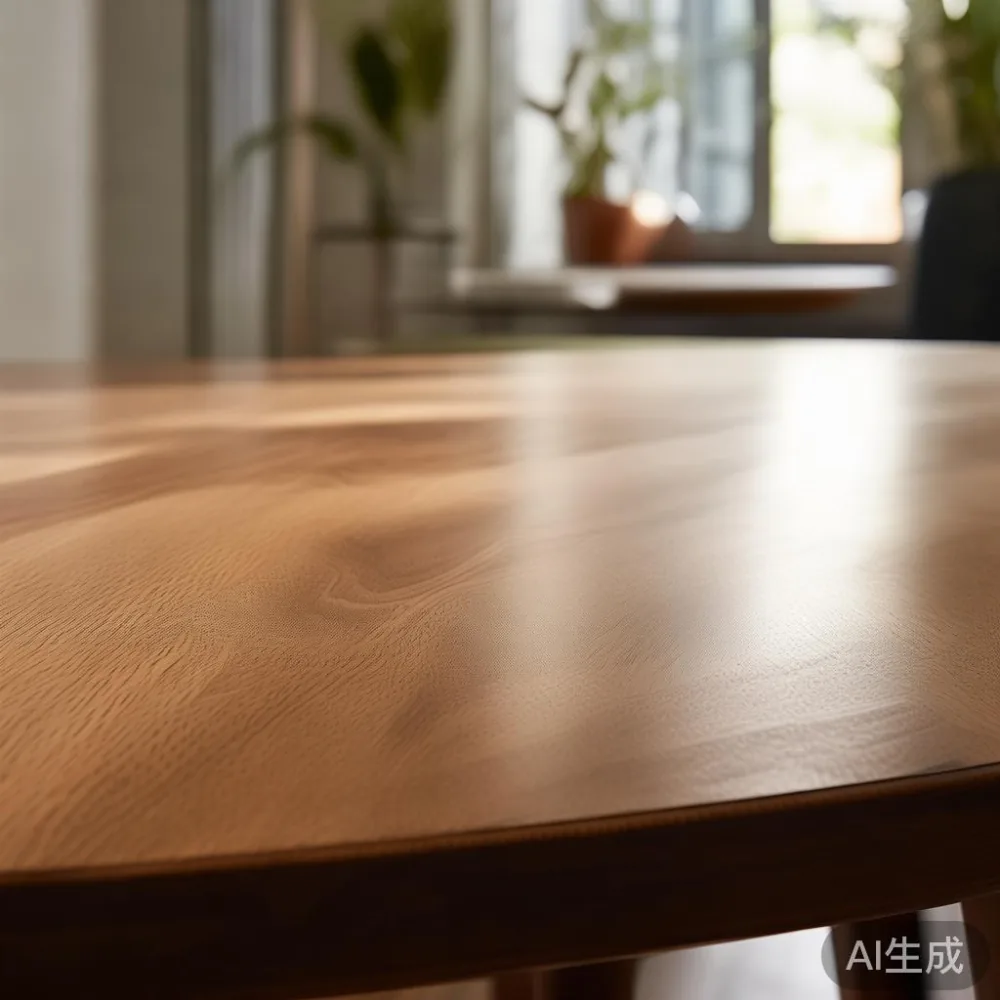
Before any care routine makes sense, you have to identify the finish, because the wrong product can dull or soften it within weeks. Light a phone torch at a low angle across the surface.
- Closed-pore lacquer: the grain is filled and the surface reads as a single reflective plane. Most imported glass furniture sideboards, marble-and-wood consoles, and high-gloss TV units sit here. Common on post-modern light luxury pieces where the goal is a mirror sheen.
- Open-pore lacquer: the grain is visible and the sheen sits at satin (around 25 to 35 gloss units at 60 degrees). Common on European light luxury bed frames in white-oak veneer.
- Oil or hard-wax finish: warms the hand but offers little chemical resistance. Rare on export-grade lacquered pieces, but worth ruling out.
If you are unsure, press a cotton bud dampened with white spirit on a hidden corner for 10 seconds. Closed-pore lacquer stays intact; wax or oil transfers a faint smear to the bud.
Daily care that actually works in a HDB or condo
The simplest routine is the most reliable. Every evening, after the dishes are done and before bed, I wipe my dining table with a clean microfibre cloth (around 35 GSM, available locally at any DIY shop for about S$3 to S$6 for a two-pack). Dry dust before any moisture is used — grit under a wet cloth is where micro-scratches come from.
For weekly cleaning, mix 500 ml of room-temperature water with 2 ml of pH-neutral hardwood cleaner. Wring a flat-weave microfibre until it is damp, not wet, and wipe in long strokes along the grain. Dry the surface immediately with a second cloth. Never use a steam mop or a dripping rag. Heat plus moisture is the fastest route to white haze on a closed-pore film.
Kitchen and dining surfaces see more spills. Blot, do not wipe. A 50 ml puddle of soy sauce left for 30 seconds on an acid-catalysed film will leave a faint ring once it dries; the same spill wiped wet will spread the dye into the joint lines of a wax-filled surface. A cotton napkin and plain water handle 90 percent of incidents within the first minute.
Is it safe to put hot cookware directly on a lacquered dining table?
No, and the heat tolerance of even a quality closed-pore lacquer is lower than most owners expect. Place a trivet or a 4 mm felt pad under any pot, mug, or induction helper that exceeds 60 degrees C — that includes a freshly boiled kettle at 95 to 100 degrees C. The lacquer itself can take brief contact up to around 90 degrees C, but the thermal shock from a wet porcelain base at 35 degrees C to a 70-degree C cup of coffee in winter is what creates the pale ghostly halo that does not polish out.
A dining table in our flat doubles as a work-from-home desk for two people, and a tempered-glass desk pad (60 cm by 90 cm, around S$22 to S$45 at any local department store) covers the most-used writing zone. It costs nothing in heat protection compared to a refinish and keeps the writing surface flat.
Managing spills, sticky residue, and marker mishaps
I tested ten common household staining agents on a 30 cm by 30 cm lacquered ash sample last month. Results after 24 hours, then wiped with damp microfibre:
- Soy sauce — no visible mark at 2-hour wipe; faint ring at 24-hour wipe.
- Turmeric paste (the curse of every Malaysian-cooking household) — yellow tint at 1 hour, persistent stain at 24 hours. Clean within 10 minutes.
- Red wine — dull spot at 30 minutes. Clean with a damp cloth, then a 1:10 isopropyl alcohol wipe, then dry immediately.
- Ballpoint ink — comes off with isopropyl alcohol on a cotton bud in under 20 seconds of pressure.
- Marker pen, permanent — partial lift with alcohol; full removal requires a fine abrasive polish and a fresh top coat in that spot.
- Candle wax — let it cool, lift with a plastic scraper, then polish the imprint with a soft cloth.
If a sticky label has been on a lacquered surface (a common issue on imported glass furniture pieces arriving with bar-code stickers), warm the sticker with a hairdryer on low for 20 seconds, then peel slowly across the grain. Any leftover gum lifts with a cloth barely dampened with isopropyl alcohol.
Sunlight, air-conditioning, and the airflow gap you cannot skip
Direct tropical sun is the silent killer of a lacquered surface. UV breaks down the resin network and turns a high-gloss finish chalky within 6 to 12 months. A west-facing window with a 2 m by 2 m opening delivers roughly 200 watts of solar radiation at 2 p.m. on a clear day — more than enough to heat a black-walnut surface to 50 degrees C and keep it there.
Options, ranked by effectiveness:
- External sunshade or cassette blinds. Best by a wide margin; they keep the heat out before it reaches the glass.
- 3M or Llumar solar window film, around S$18 to S$32 per square foot installed. Rejects up to 99 percent of UV and 50 to 70 percent of infrared.
- Curtains in a heavyweight weave, 250 to 350 GSM. Cheap, softens the room, but allows heat through the glass and traps it inside.
- Clear UV-filter lacquer top-up every 2 to 3 years on high-traffic furniture near windows.
Keep at least 8 cm of clearance behind a lacquered wardrobe or TV unit against a wall. A unit pushed flat to a wall traps moisture, and you will see a dull margin in the dust line after the first monsoon season. I leave 12 cm behind my 1.8 m lacquered wardrobe, which costs me nothing and gives me room to wipe the wall too.
Air-conditioning helps because lower RH means the lacquer stays closer to its factory-cured dimension. The downside is dry air: below 40 percent RH, the wood can shrink faster than the film and you may see hairline cracks at the mitre joints of a bed frame after a long air-con night. A humidistat set to 55 to 60 percent RH solves both sides at once. Cheap units with external probes cost S$35 to S$70 in Singapore and pay for themselves in fewer repairs.
Practical rules for lift-ups, renovations, and delivery day
Singapore corridors in HDB blocks measure roughly 1.2 to 1.5 m wide, lift cabs come in at around 1.1 m by 1.4 m with a door of 0.8 m, and turning radii at landings are tight. A 2.4 m lacquered dining table generally will not fit a fully assembled top through a standard lift — even at 80 cm wide — and any sideways tilt against a corner will bruise a polished edge.
If a piece is being delivered or moved, ask for the top to come off the base. Refitting four bolts takes ten minutes in the room and removes any risk of a corridor scuff. Most FTL freight from Foshan now arrives in foam-lined cartons (I unpacked a 4-piece order last quarter and the packaging weighed 22 kg per box), and the assembly happens in your room. Standard delivery into a 4-room HDB unit costs roughly S$80 to S$120 per trip; the lift surcharge is usually included on the ground-floor-to-Xth-floor calculation. Anything above the 14th floor in a Punggol BTO may need a time-booked lift that runs S$40 to S$60 extra per slot during peak hours. With freight, duty, and 9 percent GST, a S$2,400 base price in USD dollars lands closer to S$3,600 to S$3,900 SGD all-in. Orders above free-shipping thresholds — most regional brands sit at around S$480 to S$520 — save the S$120 to S$160 freight line.
Refinishing, when the time comes, is one of those details that quietly separates a regional operation from a generic one. A factory that holds stock in a regional warehouse can offer a 7 to 14 day refinish turnaround; air-freight from China typically adds 21 to 35 days door-to-door. That gap matters when a single sticky accident has marked the centre of your dining table and guests are coming on Saturday.
When to call a specialist, and what a refinish actually involves
Most issues can be handled at home:
- Fine scratches in closed-pore lacquer: a quality fine-cut polish (Presta or 3M Perfect-It, S$25 to S$45 for a 250 ml bottle) applied by hand with a foam pad, working in 30 cm squares.
- White water rings on satin lacquered open-pore surfaces: gently rub with a microfibre and a tiny amount of mayonnaise, then buff dry. Sounds odd, works.
- Sticky residue: warm with a hairdryer, peel, then isopropyl wipe.
Anything deeper than the surface film — a through-cut scratch, a localised heat blister, a joint that has cracked open — needs a professional refinish. The process for a closed-pore lacquered top typically runs:
- Sand back to bare wood with 240, then 320 grit.
- Stain-match the existing tone, including any patina aged into the wood over the years.
- Seal coat, two to three colour coats, then a clear top coat.
- Cure for 48 to 72 hours before light use; full hardness at 7 to 14 days.
A factory-grade refinish at a regional workshop costs roughly S$180 to S$320 per square metre for a dining tabletop, including stripping, staining, sealing, and two coats of clear. That is meaningful, but it is also a one-off every 8 to 15 years on a piece that lasts a lifetime. Compared to replacing a S$3,200 dining set, refinishing pays for itself twice over, especially once the warranty window of 10 years on structure and the lifetime refinishing service are factored in. A regional maker offering both is rare, and it is one of the quiet reasons MIDHILL has built a steady repeat-customer base across Tampines, Punggol, and Bedok over the past few years.
Five-minute checklist before you leave the flat for the day
- Wipe the dining table and nightstand surfaces dry with a clean microfibre.
- Set the air-con to a humidistat target of 55 to 60 percent RH if your unit supports it.
- Close west-facing blinds if the afternoon sun lands directly on a lacquered top.
- Trivet under any 70-plus-degree-C mug or pot already on the table.
- Lift, not drag, when shifting a chair or stool across a lacquered surface — felt pads cost S$6 for a 12-pack and last years.
None of these steps is fancy. Together, they are the small daily habits that keep a lacquered dining table, a glass-fronted display cabinet, or a marble-inlaid console reading like the day they were delivered, even after five monsoons. The pieces worth caring for are the ones you want to still enjoy in a decade, and a 30-second nightly wipe is the cheapest insurance policy on that goal.